
Free SEL Coloring Pages: Theo, Chloe & Edgar for the Classroom
Looking for SEL coloring pages for kids that actually connect to your curriculum? You're in the right place.
Coloring is quiet. It's focused. It asks something of a child's hands and gives something back to their mind. For students navigating big emotions, that combination — the repetitive motion, the soft concentration, the sense of completion — can be genuinely grounding.
Roylco's three SEL companions are designed for exactly those moments. Theo the Therapy Dog, Chloe the Comfort Cat, and Edgar the Emotions Puppet each anchor a different corner of social-emotional learning. Together, they give teachers a warm, familiar cast of characters to bring emotional vocabulary, coping strategies, and self-awareness into the classroom.
The free coloring pages below feature all three. Use them as a standalone calming activity, a discussion starter, or a creative extension to your SEL curriculum.
Why Coloring Pages Work for SEL
Before diving in, it's worth understanding why coloring and SEL are such a natural fit — because it's not just about keeping hands busy.
The repetitive motion of coloring activates the same calming neural pathways as breathing exercises and mindfulness activities. Research on fine motor development shows that focused hand work helps children regulate arousal levels, making it easier to engage in conversation, reflection, or instruction immediately afterward. For students who struggle to verbalize emotions, a coloring page featuring a character they recognize and trust becomes an accessible entry point.
Coloring also builds fine motor strength — pencil grip, pressure control, staying within lines — skills that 77% of primary teachers report are declining in their students. An SEL coloring activity does double duty: it supports emotional regulation and builds the hand skills children need for writing.
Download Free SEL Coloring Pages

Theo the Therapy Dog Coloring Pages
Theo is Roylco's weighted therapy dog companion — designed to be held, hugged, and trusted during moments of emotional overwhelm. In the classroom, Theo is a go-to tool for transition time, anxiety, and sensory regulation.
The Theo coloring pages feature him in a range of calm, reassuring poses — curled up, being held, sitting quietly beside a child. They pair naturally with conversations about:
- What it feels like to need comfort
- How animals help us feel safe
- Identifying the physical sensations of anxiety or stress
Classroom tip: After students finish coloring their Theo page, invite them to write or dictate one thing that helps them feel calm — just like Theo does. Post the finished pages alongside the Theo stuffed companion for a cozy reading corner display.
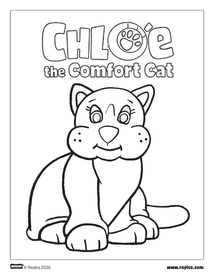
Chloe the Comfort Cat Coloring Pages
Where Theo is grounding and calming, Chloe the Comfort Cat brings a slightly different energy — curious, gentle, and reassuring in a quieter way. Chloe works especially well for students who connect more with independence and self-soothing than with external comfort.
The Chloe coloring pages feature her in expressive poses that mirror emotional states — curious, content, cautious, cozy. They open up language around:
- Emotions that are harder to name (loneliness, nervousness, contentment)
- Self-regulation strategies ("What does Chloe do when she feels nervous?")
- Empathy and perspective-taking
Classroom tip: Use the Chloe coloring page as a check-in tool. Ask students to circle the Chloe pose that matches how they're feeling today, then color the one that shows how they want to feel. It's a simple, low-pressure emotional temperature check.
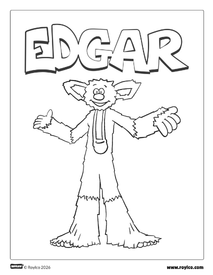
Edgar the Emotions Puppet Coloring Pages
Edgar is the most explicitly curriculum-connected of the three. As an emotions puppet, his entire purpose is to name, show, and explore feelings — making him a natural anchor for formal SEL lessons, morning meetings, and guided discussions.
The Edgar coloring pages feature him displaying distinct emotions with clear facial expressions. They support:
- Emotions vocabulary building (happy, frustrated, worried, proud, surprised)
- Facial expression recognition — a foundational empathy skill
- Storytelling and role-play extensions
Classroom tip: After coloring, students can cut out their Edgar and use him as a mini puppet to act out a scenario where a character feels that emotion. It extends the activity from coloring into dramatic play — and gives quieter students a way to express and process without speaking directly.
How to Use These Pages as a Set
The three characters work individually, but they're even more powerful together. Here are a few ways to use them as a complete SEL toolkit:
Morning meeting warm-up: Place all three coloring pages at a center. As students arrive, they choose the character that matches their mood and begin coloring. By the time the morning circle begins, you have a visual snapshot of where each student is emotionally — without anyone having to say a word out loud.
Calm-down corner anchor: Keep a small stack of all three pages in your calm-down corner alongside the physical Theo, Chloe, and Edgar companions. A student who reaches for one will naturally connect the character on the page with the tool in their hand.
SEL unit launch: Introduce each character through their coloring page before introducing the physical product. Building familiarity through art first gives students a sense of ownership and connection before the classroom tool even arrives.