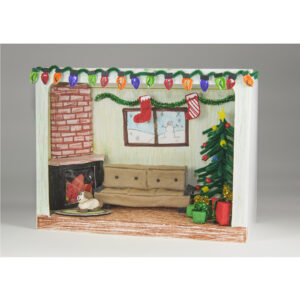
Dioramas bring learning to life. Students build real, three-dimensional scenes. They research, design, and create something they can actually be proud of. A strong diorama project works across subjects — science, history, ELA, and social studies all fit the format well.
Below, find seven diorama box ideas for school projects. Each one includes Roylco paper and craft picks to help students build a scene worth displaying.
What You Need to Get Started
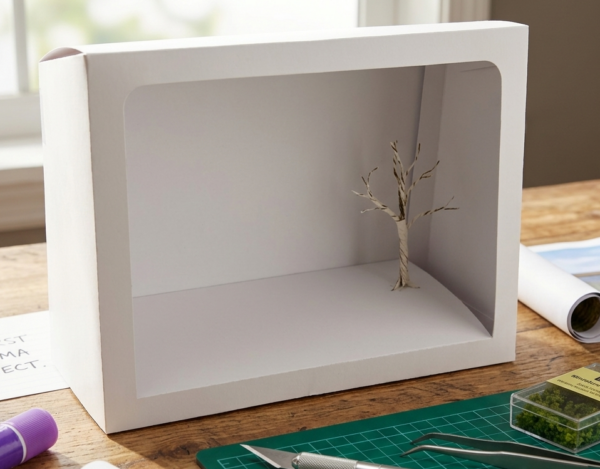
Roylco's Set the Scene Diorama Box is the right foundation. Each pack includes 12 fold-up boxes. They assemble without glue — scored lines and locking tabs do the work. Each box folds flat to 8.5" x 11", which makes it easy to decorate the interior before assembly. Students paint, draw, or collage the inside first. Then they fold, lock, and add their three-dimensional elements.
The result is a sturdy, display-ready scene that holds up to mixed media — paint, paper, yarn, clay, and more.
7 Diorama Box Ideas for School Projects
1. Ocean Habitat
Students choose an ocean zone — sunlit, twilight, or midnight — and populate it with real creatures. They research food chains, light levels, and plant life. Then they build it in three dimensions.
How to build it: Paint the interior in deep blues and greens before folding. Layer paper sea plants along the floor. Hang fish and jellyfish from the top with thread.
Roylco picks:
- Color Diffusing Paper — lightly mist with blue and green watercolor to create a glowing, layered ocean background
- Decorative Hues Paper — cut into coral, kelp, and sea creature shapes
2. Rainforest Layers
The rainforest has four distinct layers: forest floor, understory, canopy, and emergent. Each layer holds different animals, plants, and light conditions. This project works as a science assignment and doubles as a stunning display piece.
How to build it: Decorate the back panel with each layer. Use paper to build trees that rise from the floor. Layer the canopy near the top.
Roylco picks:
- Leaf Rubbing Plates — create detailed, realistic leaf prints for foliage and ground cover
- Color Diffusing Paper — use dappled gold and green tones to suggest light filtering through the canopy
3. Ancient Civilizations
Ancient Egypt, ancient Greece, Mesopotamia, the Aztec Empire — this theme fits almost any history curriculum. Students research architecture, daily life, and key figures. Then they recreate a scene from that world inside the box.
How to build it: Start with a warm, sand-colored interior. Build small pyramids, columns, or temples from folded card stock. Add figures and artifacts cut from paper.
Roylco picks:
- Antique Paper — Use around the edges or to create scrolls
4. Book Report Scene
Instead of a written summary, students pick the most important scene from a book and build it. This format works for fiction, mythology, and historical novels. It challenges students to identify a turning point and visualize it spatially.
How to build it: Students design the setting first — indoors or outdoors, time of day, season. Next, they build or draw the characters and key objects. Finally, they label the scene with a short caption.
Roylco picks:
- Decorative Hues Paper — use richly patterned sheets to build interior settings, wallpaper, and furnishings
- Color Diffusing Paper — create dramatic sky effects for outdoor scenes
5. Animal Habitat
Students pick one animal and build its natural home — a beaver dam, a polar bear's arctic terrain, a rabbit warren, or a bird's nest in the canopy. The research is substantial. Students must identify food sources, shelter type, and climate for their chosen animal.
How to build it: Cover the interior with the right landscape — snow, grass, mud, or sand. Build the shelter structure next. Then add the animal and its food sources.
6. Community and Neighborhood Map
This idea works especially well for K–2 social studies. Students build a bird's-eye view of their community — their school, a park, a fire station, a grocery store. It builds map skills, spatial reasoning, and community awareness at the same time.
How to build it: Lay the diorama box flat and use it as a map base instead of folding it into a box. Students draw or build the buildings from the top down. Roads, sidewalks, and green spaces fill in around them.
Roylco picks:
- Matisse Collage Shapes — use bright geometric shapes as building footprints, parks, and roads
7. Water Cycle and Weather
Students illustrate the water cycle — evaporation, condensation, precipitation — in one cohesive scene. Alternatively, they recreate a weather event: a thunderstorm over a city, a blizzard on a mountain, or a tornado on a plain. This theme aligns with earth science standards across multiple grade levels.
How to build it: Use the interior as both sky and ground. Hang cloud and precipitation elements from the top with thread. Build the landscape elements along the floor.
Roylco picks:
- Color Diffusing Paper — create dramatic storm clouds or a rainbow-after-rain sky
- Stained Glass Paper — cut into lightning bolt shapes, or use its translucency to suggest flowing water
Tips for a Great Diorama Project
- Decorate the interior first. Always paint or collage the inside of the box before folding and assembling. A flat surface is far easier to work on than an assembled box.
- Build in layers. Start with the background — sky, ground, water. Then add the midground elements — trees, buildings, terrain. Finally, place the foreground figures and details. Layering this way creates real visual depth.
- Mix your materials. Combine Roylco papers with yarn, fabric scraps, natural objects, or air-dry clay. Texture and dimension make a diorama memorable.
- Label key elements. For science and social studies projects, add small labeled cards to the scene. Labels show understanding and strengthen the connection between the visual and the learning objective.
For more on how dioramas support project-based learning across subjects, Edutopia's PBL resource library is a strong starting point for teachers planning cross-curricular units.
Ready to Build?
Roylco's Set the Scene Diorama Box gives every student their own workspace — 12 fold-up boxes per pack, ready to decorate, assemble, and fill. Pair it with Color Diffusing Paper, Decorative Hues Paper, or any of the Roylco picks above for a complete, cross-curricular project with almost no prep required.
How to Use the Diorama Box Kit: Tips & Lesson Ideas
Here are some practical steps and creative ideas for integrating the diorama box into classroom or home projects:
1. Choose a Theme / Prompt
Decide whether students will depict scenes from:
-
A historical event (e.g. A Revolutionary War skirmish)
-
A book or myth (e.g. Little Red Riding Hood, The Odyssey)
-
A natural habitat or ecosystem
-
A future world or fictional city
2. Plan the Layers
Have students sketch their scene in three zones: foreground, middle, and background. Encourage them to think about what elements belong in each layer.
3. Decorate the Background / Base
Before folding, students can paint, draw, or collage the interior walls (sky, mountains, walls) and floor (grass, carpet, streets).
4. Add Cut-Out Figures / Props
Use paper cutouts, plastic figures, or small 3D models. Students can fold tabs on props so they stand upright inside the diorama box.
5. Assemble the Box
Fold along scored lines, slide locking tabs, and secure flaps. Then insert props in layers — front to back — for a structured visual effect.
6. Present & Reflect
Display the dioramas and have students present their scenes. Ask questions like: Why did you put that tree in front? What if you moved the river? Reflecting helps deepen spatial and narrative reasoning.
shadow box, diorama box kit, diorama kit for schools , diorama box for projects , shoebox project box, shoebox project box diorama box