
There's something genuinely magical about folding a flat sheet of paper into a heart. No glue, no scissors, no mess — just a few intentional folds and something beautiful appears in your hands. Origami hearts make perfect valentines, bookmarks, cards, and classroom decorations, and they're accessible enough for kids as young as five with a little guidance.
In this tutorial, we'll walk you through how to make an origami heart for Valentine's Day step by step, recommend the best Roylco paper for the job, and link you to a video walkthrough so you can follow along visually.
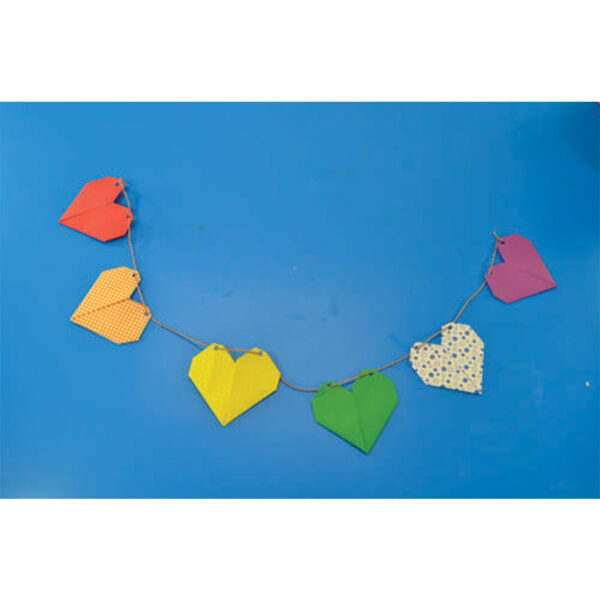
What You Need
- One square sheet of paper (6" x 6" works well for beginners)
- A flat surface for clean creasing
- Optional: a bone folder or the edge of a ruler to sharpen folds
That's it. No tape, no glue, no extras.
How to Make an Origami Heart: Step-by-Step Instructions
Follow these 10 steps carefully. Crease each fold firmly before moving to the next — clean creases make the difference between a crisp heart and a crumpled one.
Step 1: Start with your square, colored side down
Place your paper on a flat surface with the white or plain side facing up and the patterned or colored side facing down.
Step 2: Fold in half horizontally, then unfold
Bring the bottom edge up to meet the top edge. Crease firmly along the center, then unfold completely. This crease marks your center guide line.
Step 3: Fold the top edge down to the center crease
Take the top edge and fold it down to meet the horizontal center crease you just made. Crease well.
Step 4: Flip the paper over
Turn the entire paper over so the folded strip is now face down at the bottom.
Step 5: Fold the bottom-left corner up diagonally
Fold the bottom-left corner up at a 45° angle so it meets the top-center point of the paper.
Step 6: Fold the bottom-right corner up diagonally
Mirror Step 5 on the right side. Fold the bottom-right corner up at a 45° angle to meet the top-center. Your paper now looks like a house or pentagon.
Step 7: Flip the paper over once more
Turn the paper over again. The two diagonal folds you just made will now appear as the bumps at the top of your heart.
Step 8: Fold the top-left bump corner down
Take the outer top-left corner and fold it downward at a slight angle to soften and round the left bump of the heart.
Step 9: Fold the top-right bump corner down
Repeat on the right side. Fold the outer top-right corner downward to match. Both bumps should now look smooth and rounded.
Step 10: Fold the bottom point up slightly
Take the very bottom tip and fold it upward just a small amount to create a clean, flat bottom edge on your heart.
Watch It in Action: If any step feels unclear, watching the folds in motion makes a big difference. EZOrigami's video tutorial walks through the classic heart fold clearly and at a beginner-friendly pace — a great companion to these written steps.
The Best Roylco Papers for Origami Hearts
The paper you choose changes everything. A plain white sheet works, but a beautifully patterned or colored sheet turns your origami heart into something worth framing.
Decorative Hues Paper is our top pick for Valentine's Day origami. With 192 sheets across 64 unique designs in 8 color schemes — including warm reds, pinks, and jewel tones — it gives every student a different heart and makes a stunning classroom display. Each sheet is 5.5" x 8.5", so simply trim to a square before folding.
Really Big Origami paper is ideal when you want to practice the folds first or create oversized hearts for bulletin boards and door decorations. Larger paper means more forgiving folds — perfect for younger folders building confidence.
Color Diffusing Paper adds a watercolor-like quality to each heart. Lightly mist or brush the finished heart with water and a drop of liquid watercolor to create a soft, blended effect that looks like stained glass. It's a beautiful two-step project for older students.
Classroom Ideas for Your Origami Hearts
Once your students master the fold, the project doesn't have to stop at the heart itself. Consider these extensions:
- Writing inside the fold: Before the final flip, have students write a kind message or Valentine's note in the interior, then fold it closed. The heart becomes its own envelope.
- Bulletin board garland: String finished hearts together for a hallway or classroom Valentine's display.
- Math connection: Discuss symmetry and geometry as you fold — the heart is a perfect, tactile example of a line of symmetry.
- Fine motor practice: For younger students, the deliberate folding and creasing builds exactly the hand strength and precision that supports early writing skills.
Final Thoughts
Learning how to make an origami heart for Valentine's Day is one of those rare activities that works beautifully across ages, subjects, and skill levels. It's process art, fine motor practice, and a handmade gift all in one — and it starts with a single square of paper.
Try it with Decorative Hues Paper for a classroom set that looks like it took all day, even when it took ten minutes.
Want more Valentine's Day classroom ideas? Browse the Roylco blog for seasonal craft projects, STEAM activities, and educator resources.